FIRE is often interpreted as a numerical formula for saving and investing.
But at Playfish Lab, we focus more on how an ordinary person can avoid being completely drained by work while steadily moving towards freedom.
This article is our starting point for dissecting the relationship between 'slow productivity and FIRE'.
Have you ever had such moments?
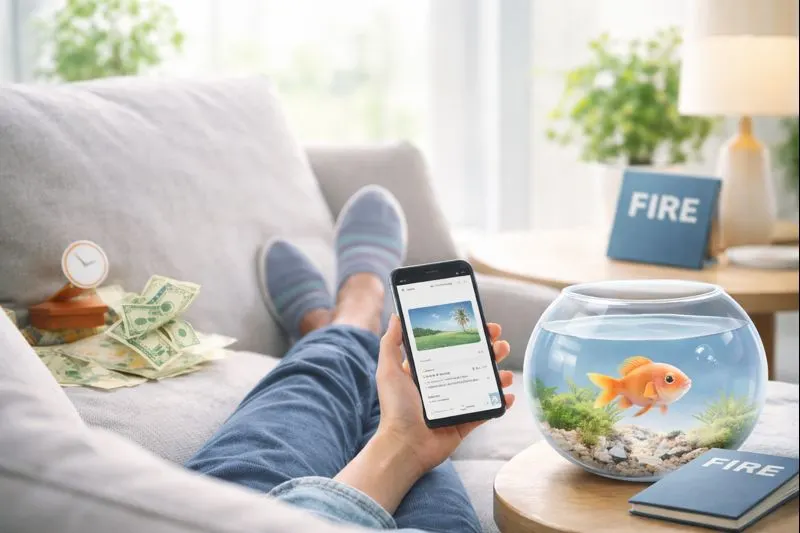
Collapsing on the sofa after work, scrolling through posts about the FIRE movement, envying others who achieve financial freedom and travel the world in their thirties, while feeling tightly bound by work with no time to catch a breath.
Always thinking, 'I'll start planning once I save my first pot of gold' or 'I'll study finance when I'm less busy,' but as days go by, the busyness doesn't decrease, and the goal of freedom seems further away.
The key is: when work takes up the most and the best hours of your day, what truly determines your path to FIRE is never a single big payday, but how you use your time now.
For this reason, the first step towards FIRE is never 'making big money,' but first learning to—engage in effective slow productivity.
1. 'Atomic Habits' × FIRE: Compounding Beyond Money, Time/Energy is More Crucial
If you’re interested in FIRE (financial independence, early retirement), you’ve probably heard of Atomic Habits.
Its core logic is almost disarmingly simple: save up 25 times your annual expenses, keep your annual spending below 4% of your assets, and even if you do not work for 30 years, compound returns can keep you afloat.
In essence, it's about continuously saving and investing, and after decades, relying on the funds in your account to escape the vicious cycle of 'working to survive' and unlocking freedom early. Doesn't that sound appealing?
However, many people fall into the trap of focusing solely on 'monetary compounding,' while ignoring the core of 'Atomic Habits'—
compounding is never limited to money, the accumulation of time, energy, and even experiences can produce astonishing compounding effects.
What this book truly wants to tell us is: it's not grand goals that change lives, but small, repeatable systems.
There are just two core logics:
- A 1% small change can leverage big results, optimizing the way you use your time by 1% every day can compound into a 37× difference over a year.;
- Systems are more important than goals, instead of fixating on vague goals like "earning a million," it's better to build small habit systems that can be implemented daily.
For most of us, the most time is spent on work each day.
If you want to seize the compounding effect of time and energy, and even create the compounding of memories and experiences, the key is to optimize the way time is used at work—
It's not about selling every minute to work, but about finding the smallest actionable unit that can be repeatedly executed, so that every bit of work time investment empowers your long-term value.
So, what is the smallest actionable unit of FIRE? Is it tightening your belt and not drinking milk tea? Is it saving an extra dollar every day?
None of these! There's only one answer—effective slow productivity. It is precisely our core tool for leveraging the compounding of time and energy at work.
2. Effective Slow Productivity ≠ Slacking: It's the Key to Starting FIRE
When people hear "slow productivity," their first reaction is often "slacking" or "lack of dedication."
But the slow productivity we're talking about is completely different from passive idleness; it is "strategic whitespace"—proactively leaving an outlet for time and energy, so you're not drained by meaningless internal friction.
In the workplace, slow productivity helps you detach from ineffective busyness:
for example, by refusing unnecessary meetings, not letting spam emails disrupt your rhythm, and redirecting your energy from the ineffective internal friction of "trying to look busy for the boss" to doing things with more long-term value.
In life, slow productivity means allowing yourself not to be constantly in a state of high efficiency.
Give your brain some breathing space, and don't always push yourself to be 'useful' or 'productive.'
In my article Why 'Strategic Slowing Down' Is Essential in the 2026 Economic Downturn I mentioned:
When the overall environment is uncertain, blindly working hard won't bring a sense of security; instead, it will exhaust you faster.
It's like the "deep work time" popular in Western workplaces, which essentially relies on reasonable breaks to improve efficiency, rather than mindless overexertion.
This strategic slow productivity is essentially about creating a buffer in your life, which is a sustainable way to survive in the long run.
Simply put, every instance of slow productivity is an "active reclaiming of power"—
shifting your focus from the boss's KPIs and others' expectations back to your own life path.
This is the core starting point of FIRE: gradually shifting attention back to oneself.
If you can't even control your time in the present, how can you talk about freedom in the future?
3. The Four Compounding Powers of Slow Productivity: Helping You Accumulate FIRE Capital
Why is Slow Productivity the Smallest Unit of FIRE?
The core is that it aligns with the compound interest logic of 'Atomic Habits'—seemingly insignificant small actions, accumulated over time, will help you build a solid FIRE foundation across four dimensions.
3.1 Time Compound Interest: Building a New Skill Tree
Don't think of the time spent on slacking as useless fragments.
Use the time during boring morning meetings to outline a side hustle, listen to side hustle podcasts during commutes, learn five words in a target language, and read a finance book for 15 minutes during lunch breaks—
Over a year, this accumulates to dozens of hours, and after a few years, you can build a whole new skill tree.
Many overseas FIRE bloggers have shared that their first source of passive income was slowly figured out during slacking at work.
3.2 Money Compound Interest: Saving the 'ransom' to escape the workplace
Slacking is not about wasting time on short videos, but about researching finance and planning regular investments.
Minimum unit: even if you only invest $100 per week.
Compared to 'waiting to make big money before investing,' these small investments made during fragmented time are easier to maintain and more in line with the essence of compound interest.
A few years later, this money will be your 'ransom' to escape the workplace in the future.
3.3 Health Compounding: Preserve the Capital for Enjoying Freedom
Many people, in pursuit of 'efficiency,' eat while staring at their computers, and over time, their health deteriorates.
However, slow productivity breaks, like stretching on the way to the restroom, taking a 10-minute walk at noon, or stretching for 5 minutes between work sessions—
these actions may not qualify as 'hard work,' but they can delay burnout.
You must understand that the core of FIRE is 'long-term freedom,' and no amount of money is useful if your health fails. Health is the capital that allows you to spend money well in retirement..
3.4 Relationship Compounding: Accumulate Valuable Emotional Support
Ineffective socializing in the workplace can be discarded, but emotional investments during slacking time are invaluable.
For instance, sending a greeting message to an old friend, ordering a small gift for family, or having a chat—
these relationships will become important emotional support and social capital in the future.
Many early retirees say that life after gaining freedom is not lonely because they have built these high-quality relationships beforehand, rather than just burying themselves in work.
Ultimately, the core logic of FIRE is:
Reduce ineffective consumption and continuously invest limited resources in yourself..
Essentially, slow productivity is about doing this—allocating resources saved from internal consumption entirely to oneself, allowing every effort to generate long-term compound interest.
4. Beyond the Workplace: Slow Productivity in Life, Rejecting Boundless Overextension
Many people think slow productivity only belongs in the office, but that's not true.
True slow productivity is about carving out an undisturbed little space for yourself in the midst of a busy life.
After all, it's not just work that drains us, but also the pervasive responsibilities, expectations, and boundless giving in life.
You may love your family and cherish close relationships, but even the closest relationships can be exhausting without boundaries.
For example, as soon as you walk in the door after work, you're overwhelmed by household chores and the needs of caring for family members, leaving no time for even 10 minutes of quiet daydreaming.
For example, constantly compromising in intimate relationships without taking the time to ask yourself if you're tired;
For example, feeling suffocated by the roles you are 'supposed to' play.
Many people deal with their bosses at work and then have to meet family expectations at home, like a power bank on standby 24/7, gradually getting drained.
And slow productivity in life means bravely 'detaching' at these moments:
Sitting in the car for 10 minutes after work, staying a bit longer in the shower, taking half an hour for solitude before bed, or spending half a day walking alone on weekends;
Occasionally agreeing with family on a 'no-phone dinner' and then quietly reading for a while.
This pause is not about avoiding responsibility, but about recharging—
taking care of yourself first so that you can more patiently care for your family, returning to relationships with love instead of resentment.
It's like the 'alone time' popular in Western families:
Many families explicitly set aside a period each day for 'undisturbed personal time,' even if it's just half an hour.
It turns out that such family relationships are actually more harmonious—
Truly long-term stable relationships require this kind of space, where everyone can recharge and return to the relationship as a more complete self.
5. FIRE Slow Productivity Action List (Save This for Later)
Chris Gardner, the prototype of 'The Pursuit of Happiness,' once said:
“Walk that walk and go forward all the time. Don’t just talk that talk… baby steps counted too.”
FIRE is never an overnight leap; it is hidden in those seemingly insignificant daily choices.
You don't have to do everything on this list; just pick 1-2 items and stick to them for three months. Even small steps accumulate.
5.1 Preserve Physical Assets: Lay the Foundation for FIRE
- **Ensure 7 hours of sleep **for 30 consecutive days—don't think 'sleeping one hour less can get more done'; lack of sleep only reduces efficiency.
- Exercise at least 3 times a week, whether it's running, yoga, or brisk walking; the key is to get your body moving.
- Leave your workstation at least three times a day, walking for five minutes each time, even if it's just to the break room for a glass of water or to look out the window.
5.2 Personal System Upgrade: Accumulate Knowledge During Slow Productivity
- After reading 'Atomic Habits', choose a small habit to practice for three months—such as 'reading one page before bed each day', without overextending.
- Set a 90-day learning goal, like acquiring a side skill or obtaining a practical certificate, and gradually advance using slow productivity time.
- Spend two hours of fragmented time each week listening to podcasts, focusing on topics like financial management or FIRE (Financial Independence, Retire Early) experience sharing.
5.3 Establish Workplace Boundaries: Swap Slacking for Efficiency
- Try the Pomodoro Technique: 25 minutes of focus + 5 minutes of rest, at least four cycles a day—these 5 minutes are 'strategic slow productivity';
- Write a three-line review each day: what you did, what problems you encountered, and what you will advance tomorrow.
- Gracefully decline at least one instance of ineffective overtime within a month—truly important work won't be ruined by refusing meaningless overtime.
5.4 Financial Security: Start with Small Investments
- Invest $100 weekly for 3 months—the focus is on cultivating a long-term investment habit;
- Establish an emergency fund account, aiming for 3-6 months of living expenses—this is the "safety net" of FIRE;
- Try low-risk side hustles: monetize articles or drawings created during slow productivity, or resell second-hand items.
5.5 Social and Emotional: Focused companionship is more precious
- Dedicate one evening a week to focus on spending time with family or the most important people—turn off work notifications, put down the phone;
- Contact at least one old friend each month to catch up;
- Regularly have a "no-phone dinner" to bring interactions back to their essence, avoiding "pretend companionship."
6. Moving Toward FIRE: No Rush—Small Steps of Slow Productivity Are Enough
Buffett once said:
"The chains of habit are too light to be felt until they are too heavy to be broken."
FIRE may sound like a distant dream, but its realization never comes from a single "get-rich-quick" opportunity.
Its foundation lies in every moment you choose to live for yourself—every strategic moment of slow productivity is a vote for freedom..
You don't need to start by aiming for "two hours of slacking every day" or "saving a million dollars immediately."
Start with the simplest things: leave work 10 minutes early for a walk today, read 5 pages of a finance book during lunch tomorrow, refuse unnecessary overtime the day after—
these small actions are like "small deposits" in your FIRE account, seemingly insignificant but gradually accumulating over time, ultimately shifting your life's focus.
Maybe not next year, maybe not in five years, but one day, you'll realize:
you can say "no" to work, "slow down" to life, and "I have a bit of freedom now" to yourself.
Looking back, you'll find that the first step towards freedom was that brave moment of "slow productivity"—when you finally dared to reclaim your time and live for yourself.
7. The Free Worldview of Playfish Lab
If you resonate with this article, you'll find a completely different worldview at Playfish Lab:
We reject the 'ascetic' approach to evolution: We do not believe in sacrificing all present joys for future freedom. True FIRE is about reclaiming control over your life starting today.
We advocate for 'smart slacking': Slow productivity is not the goal; it is about protecting your most precious assets—attention and vitality—through 'strategic pauses' in an inefficient system.
We promote 'atomic accumulation': We do not gamble or go all-in; we believe that every small habit and every tiny investment can eventually blossom into freedom over time.
Here, slow productivity is not decadence but a gentle rebellion against a mundane life.
It's not about slacking off, but about accumulating every small piece of freedom to ultimately create your own FIRE life.