
On September 22, DoorDash reached a $131.5 million settlement with New York City. More than $83 million of it involved a particularly interesting dispute: delivery workers were logged into the app and waiting for orders, but hadn’t started a delivery yet—did that waiting time count as work?(Reuters report)
This isn’t just a question for DoorDash drivers.
Regular employees also lose plenty of time to work that never shows up on a pay stub:commuting, unpaid overtime, getting ready before and cleaning up after a shift, answering work messages after hours, and all the time you have to set aside to be available for work.
Not all of that necessarily counts as paid work time under the law. But if you’re trying to decide whether a job is worth it, all of it belongs in your calculations.
That’s why we think an annual salary alone doesn’t tell you much. A better number to calculate is:
Your real hourly pay: How much does the job actually pay you for every hour it takes up?
To work that out, Playfish Lab built a “Real Hourly Wage Calculator”. Internally, we call it the “Bubble Tea Index”: Enter your income, actual working hours, commute, overtime, and extra work-related costs, and it calculates your real hourly pay—then converts it into cups of bubble tea. After all, “$43 an hour” can feel abstract. “An hour of your work is worth just 5.4 cups of bubble tea” hits a little harder.

The DoorDash Dispute: Not Delivering Doesn’t Mean Your Time Is Your Own
The settlement covers several wage-calculation issues, but the most interesting is on-call time—time spent logged into the app and waiting for orders.
Most people picture a delivery courier’s job like this:
Accept an order → Deliver the food → Get paid
But the real process includes waiting before and between deliveries:
Log on and wait for an order → Accept it → Make the delivery → Wait for the next order
If you count only the time spent making deliveries as work, the hourly rate looks a lot better on paper.
But that waiting time doesn’t disappear for the courier. Once they’ve opened the app and are waiting for the platform to assign an order, they can’t use that time however they want.
It exposes a simple truth that salary figures often hide:
A job often takes up far more of your time than the hours on your pay stub suggest.
Office workers have their own version of waiting for orders.
There’s the extra time spent commuting each day, the mandatory morning and evening meetings, messages you have to answer after work, unpaid overtime, and even the extra time it takes to get ready to leave the house for work. None of that is automatically accounted for in your annual salary.
As more companies require employees to be in the office on a set schedule again, this gap is getting harder to ignore.
Your salary may not have gone up a cent.
But you’re giving up more time to earn the same amount.
The Bubble Tea Index: How Many Cups Is an Hour of a $100K Salary Worth?
Say your annual salary is:
$100,000
If you count only 2,080 working hours a year:
$100,000 ÷ 2,080 ≈ $48/hour
That’s the hourly rate most of us are used to seeing on paper.
But suppose you also spend the following each week:
- You go into the office three days a week, with a 1.5-hour commute each day
- You work three extra hours a week without any overtime pay
- Going to work costs you an extra $200 a month in transportation and meals
Plug these numbers into Playfish Lab’s “Real Hourly Wage Calculator”, the numbers start to look different.
- Total time spent: 1,912 regular hours + 143 overtime hours + 215 commuting hours = 2,270 hours/year
- Annual income after work-related expenses: $100,000 − $2,400 = $97,600
- Real hourly wage: $43.00/hour
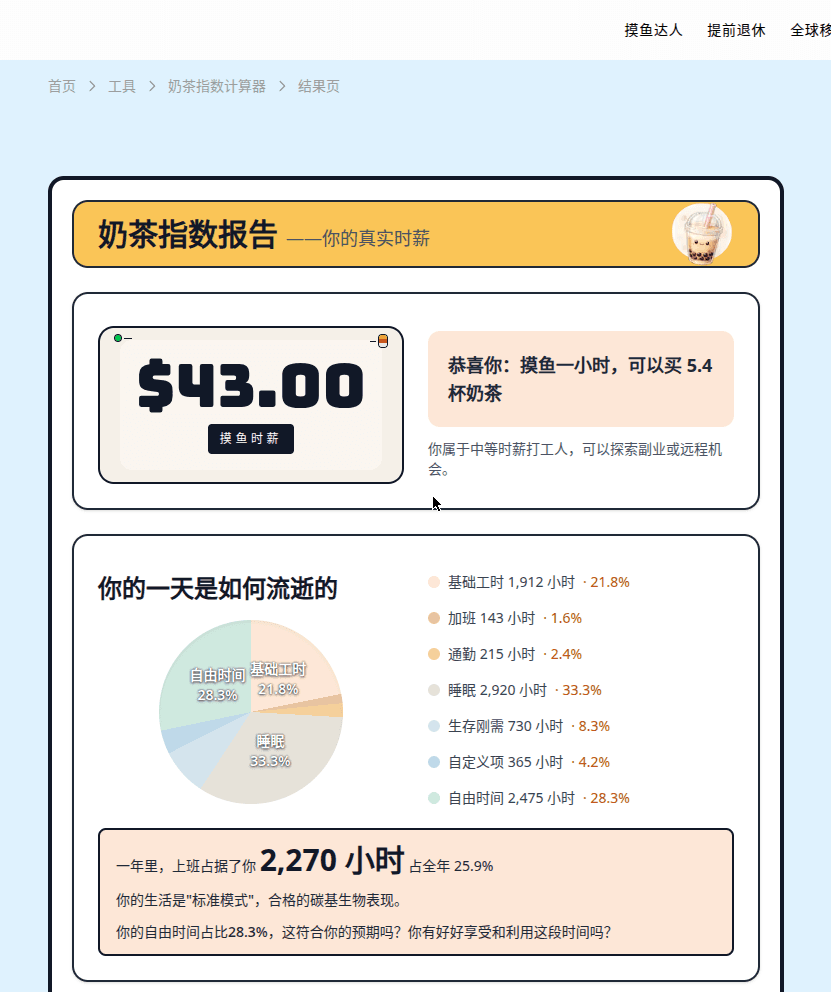
At $8 for a cup of bubble tea: $43.00 ÷ $8 ≈ 5.4 cups/hour. In other words, you earn enough for a cup every 11 minutes you work. That’s the idea behind the “Bubble Tea Index”: turn an abstract hourly wage into something you buy every day, and the gap becomes much easier to see.
That gets at what this calculator is really trying to show:
The question isn’t how high your salary is. It’s how much time and money you spend earning it.
The Real Hourly Wage Calculator accounts for two kinds of costs people often overlook.
The first is time:
commuting, unpaid overtime, getting ready for work, being expected to stay available online, and any other time your job regularly takes up.
The second is money:
transportation, parking, meals that cost more because you’re working, work clothes, equipment, and other recurring expenses you wouldn’t have without this job.
Of course, you don’t have to put a dollar value on every minute of your life.
But once you factor in the **clear, consistent extra costs that come with working over time, **a job’s real payoff can look very different from the number on paper.
Is a $100K Salary Really $10K More Than $90K?
That’s why comparing jobs based on salary alone can be so misleading.
Take this example:
Job A: $100K a year, in the office three days a week
Job B: $90K a year, fully remote
At first glance, Job A pays $10,000 more a year. But using the method above:
| Annual salary | Stated hourly rate | Real hourly rate | Bubble Tea Index | |
|---|---|---|---|---|
| Job A (hybrid) | $100K | $48.08 | $43.00 | 5.4 cups/hour |
| Job B (fully remote) | $90K | $43.27 | $47.07 | 5.9 cups/hour |
The job that pays $10,000 less a year actually has a real hourly rate more than $4 higher. What you should compare isn’t the $100K and $90K salaries on paper, but the real hourly rates for the two jobs.
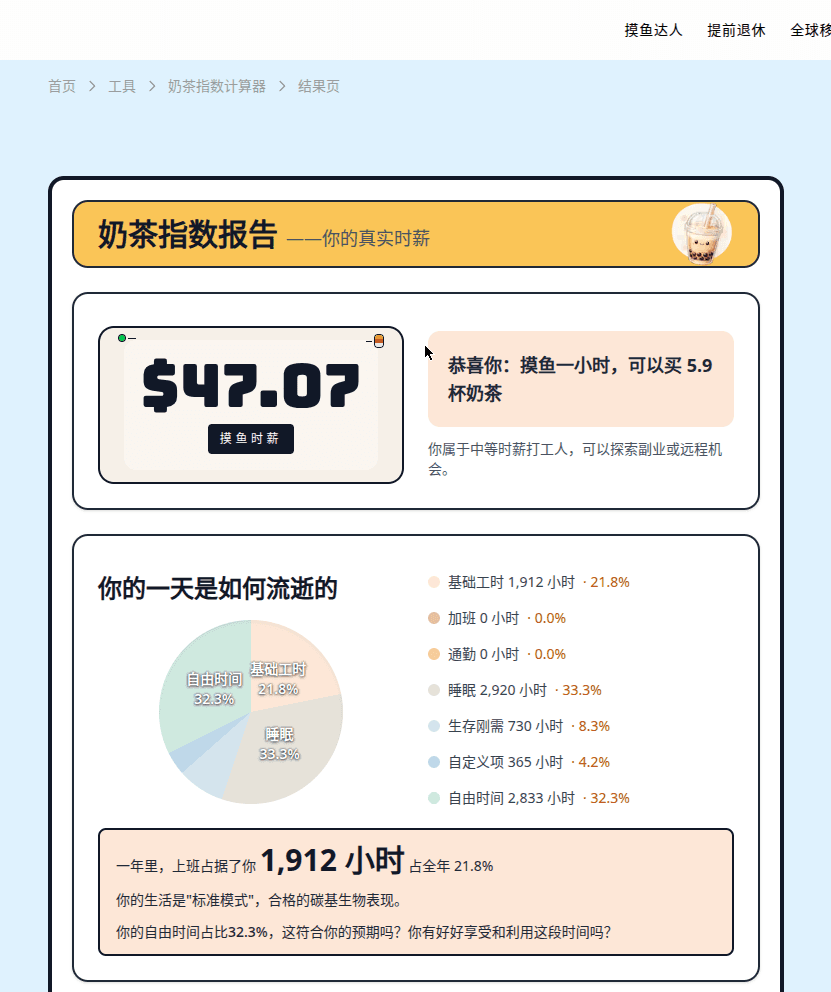
→ Before you switch jobs, do the math: How many cups of bubble tea is your time worth per hour?
That doesn’t mean remote work is always better, or that going into the office is necessarily a bad deal.
Some people prefer working face-to-face. And for certain roles, being in the office really does mean better access to resources, more chances to collaborate, and more room to grow your career.
The tool won’t choose a job for you.
It just puts an often-overlooked fact on the table:
Your time is a cost, too.
Once you’ve done the math, you can decide whether what you get in return is worth the extra time.
That Side Hustle’s “$30 an Hour” Might Not Be $30
This is especially common with DoorDash, Uber, freelance work, and other side hustles.
Say a side gig advertises:
$30 an hour
Today, you spent four hours doing the actual work and earned $120.
By the platform’s math—or if you count only the time spent on the task:
$120 ÷ 4 = $30 an hour
Looks right so far.
But you also spent:
- 1 hour waiting for jobs
- 30 minutes traveling there and back
- 30 minutes communicating and getting ready
So to earn that $120, the time you actually spent was:
6 hours
That makes your real hourly rate:
$120 ÷ 6 = $20 per hour
At $8 per cup of bubble tea: $20 ÷ $8 = 2.5 cups per hour. Put another way, you have to work 24 minutes to earn enough for one cup of bubble tea.
Factor in gas, parking, platform fees, or equipment costs, and that figure drops even further.
(Note: The calculator in the screenshot uses an annual salary input, so it displays $120 ÷ 6 hours = $20 per hour as $38,240 in annual income, based on 1,912 working hours a year. The conclusion is the same.)
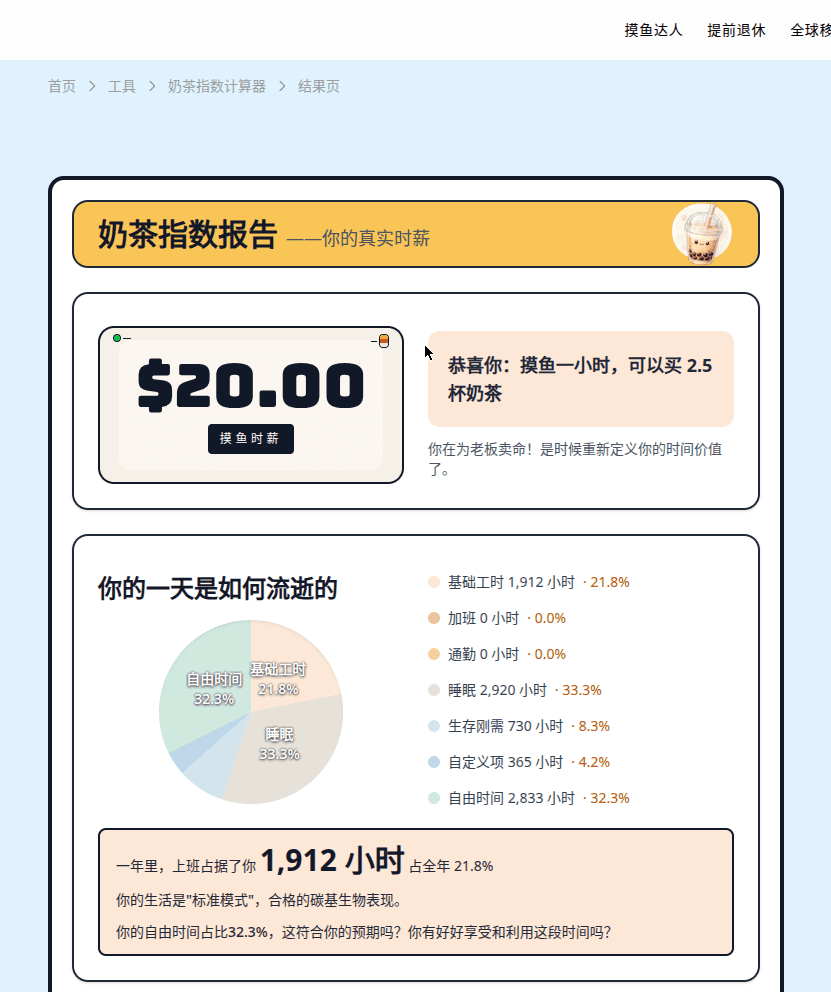
→ Try it yourself: How many cups of bubble tea is an hour of your side gig really worth?
That doesn’t necessarily mean the side gig isn’t worth doing.
It might offer flexible hours, fit into time you already have free, or help you build experience and connections—or lead to higher earnings down the road.
The key is this:
First, understand what you actually gave up to earn that $120.
Then decide whether the trade-off is worth it.
Even Time Spent “Doing Nothing” Has a Price
DoorDash’s $131.5 million settlement doesn’t mean companies now have to pay for every minute spent waiting, commuting, or getting ready for work.
First, we need to distinguish between two things:
hours an employer is legally required to pay for, and
the time costs you should factor into a career decision.
They’re not the same thing at all.
But the DoorDash dispute brings up a question that’s increasingly worth putting numbers to:
The time we write off as “on the way anyway,” “just how it works,” or “unavoidable” has been quietly shaping what a job is really worth.
For DoorDash drivers, that’s on-call time.
For office workers, it might be the commute.
For freelancers, it might be time spent waiting for clients to respond, writing proposals, and going back and forth on revisions.
For many employees, it might be nothing more than a quick reply to a Slack or text message at night.
That time won’t necessarily show up on a paycheck.
But there are still only 24 hours in a day.
So the next time you’re comparing two offers, deciding whether to accept an RTO policy, weighing a side gig, or wondering:
“Why does this job feel less worthwhile than I expected when the pay looks pretty good?”
Don’t just ask:
“How much does it pay me a year?”
Ask one more question, too:
“How much of my year does this job take up just to earn that money?”
Plug in the actual numbers and do the math. The result may be far more reliable than your gut feeling.
→ Check your Bubble Tea Index: How many cups of bubble tea is an hour of your time worth?
Frequently Asked Questions
Q: What is the Bubble Tea Index, and how does it relate to the Real Hourly Wage Calculator?
A: They’re two names for the same tool. “Real Hourly Wage Calculator” describes what it does: it shows what you actually earn per hour after work-related costs are deducted. “Bubble Tea Index” describes how it presents the result: it converts that hourly rate into the number of cups of bubble tea you could buy, making the figure easier to grasp.
Q: How do you calculate your real hourly rate?
A: The formula is simple: (annual income − work-related expenses) ÷ (all the time your job takes up, including commuting, unpaid overtime, and on-call time). With the calculator, you can get a result in 30 seconds.
Q: Does commuting time really count as work?
A: Legally, it usually doesn’t. But that’s exactly the point: when you’re making career decisions, every hour your job regularly takes from you belongs in the calculation.