

Many people planning to retire early make the same mistake when budgeting for health insurance: they focus on Medicare after 65 without properly accounting for the decade from 55 to 65. In late September, CMS released its projections for 2027 Medicare Advantage plans. The weighted average monthly MA premium is expected to fall to $12, while the average Part D premium in MA plans that include prescription drug coverage is expected to fall to $7. It’s easy to see those numbers and assume health insurance will be cheap after 65. But if you plan to retire at 55, have you set aside enough for the ten years before then?
When you're doing FIRE projections and planning your overall retirement finances, it’s tempting to assign health insurance a flat annual cost—say, $3,000 a year. Then you retire and discover the expense is anything but predictable. From 55 to 64, your premiums are tied to the income you report that year. Get your income planning wrong by a few hundred or a few thousand dollars, and your bill could multiply, potentially swallowing a year’s investment returns. Here, we’ll break down the full cost of health insurance between retirement and Medicare, the pitfalls you can avoid, and how to plan your income to keep avoidable costs down.
The Cost Curve: Why Ages 55–64 Are Less Predictable Than Medicare
Before getting into specific numbers, let’s look at the overall pattern.
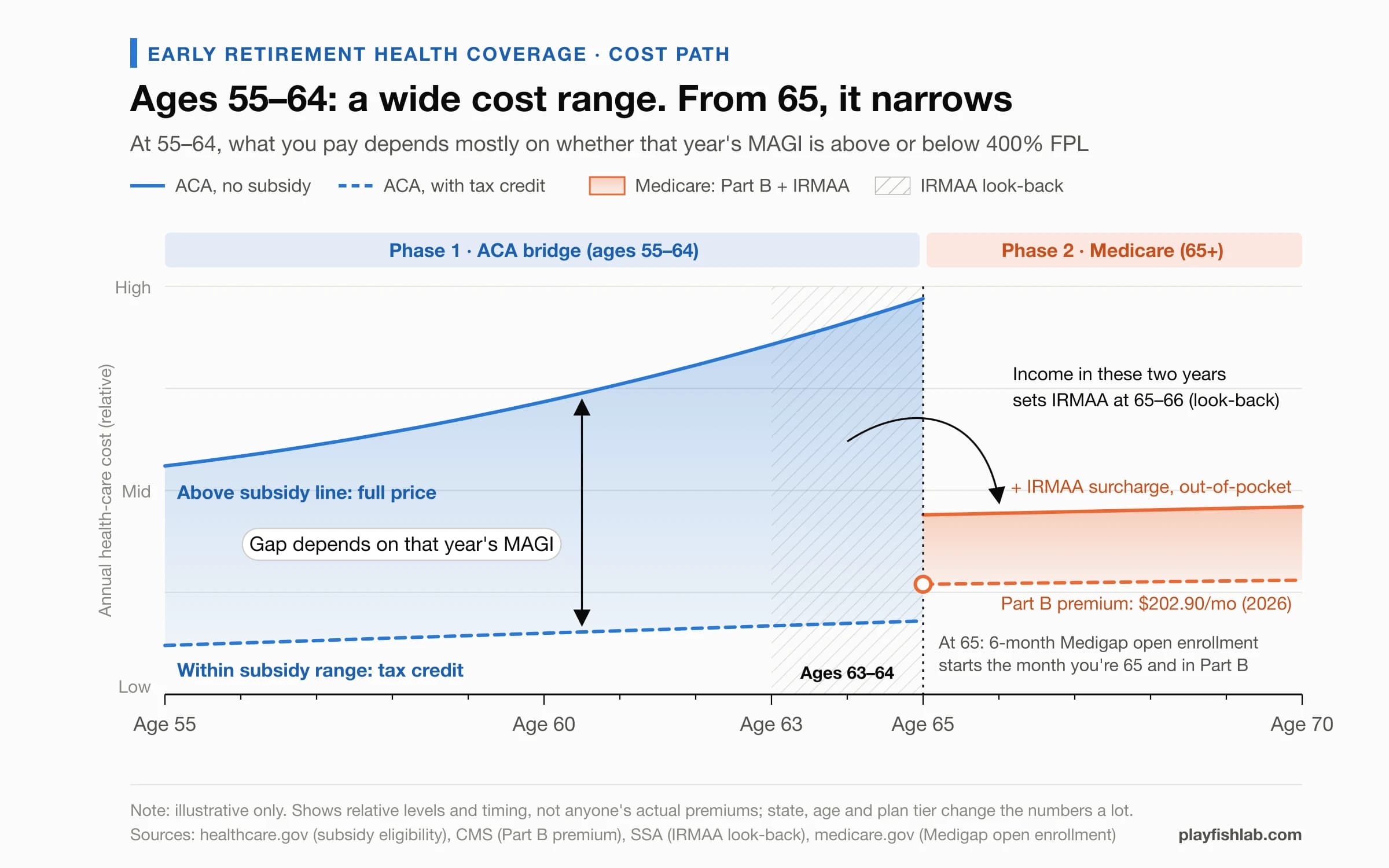
Why your health insurance budget can’t start at 65
Age 65 marks a clear dividing line. From then on, Medicare provides a public health insurance backstop, with published premium structures and out-of-pocket rules. Unless your income is high enough to trigger an IRMAA surcharge, costs are relatively predictable regardless of how much you earn.
From 55 to 64, though, you’ll need to buy private coverage through the Marketplace—what people commonly call ACA insurance. Your premiums are tied directly to the income you report that year. For someone of the same age, in the same state and on the same plan, the monthly premium could be several times higher above the subsidy cutoff than below it. There’s no single “standard cost” for this stretch. It depends heavily on how you manage your income each year, making it especially easy to lose money if you don’t know the rules.
That doesn’t mean one stage is always more expensive than the other. If you have a chronic condition after 65 and need frequent care, your out-of-pocket costs may still be substantial. But for planning purposes, ages 55–64 are far less predictable—and often the easiest part of a FIRE plan to get wrong.
The biggest cost factors: age, state, and plan choice
That’s the broad pattern. Your actual numbers can vary widely, mainly because of three factors:
First, age. Under the ACA, insurers can charge older enrollees up to three times as much as younger ones. That makes unsubsidized ACA coverage especially expensive from 55 to 64, with the full-price premium rising as you approach 65. It’s also why the subsidy cliff can hit particularly hard at these ages.
Second, your state. Competition among insurers varies by state, so premiums for the same age and plan tier can differ substantially across state lines. Check actual prices where you live on HealthCare.gov or your state’s marketplace.
Third, your plan choice. Bronze plans have the lowest premiums but higher out-of-pocket costs. Gold and Platinum plans have higher premiums but lower out-of-pocket costs. Silver is the only tier eligible for cost-sharing reductions. The right choice depends on how much care you expect to need that year.
If you and your spouse retire early, work out your health insurance costs separately. Whoever turns 65 first moves to Medicare, while the younger spouse stays on ACA coverage. Don’t use one estimate for the whole household. If you can find a bridge job with health benefits, health insurance may be much less of a strain during those ten years, and you won’t need to manage your income quite so precisely. But if you plan to live entirely off your savings, you need to understand the ACA subsidy rules.
The ACA’s 400% FPL Subsidy Cliff: $1,000 More in Income Could Cost You $8,000
Many people know the ACA offers subsidies but don’t realize they can disappear at a cliff rather than taper off gradually. Cross a certain income threshold, and the subsidy drops to zero.
The key subsidy threshold: where your income falls
Under the current rules, households with income between 100% and 400% of the federal poverty level (FPL) may qualify for a premium tax credit. Above 400% FPL, there’s no subsidy. The FPL thresholds change each year, and the 400% FPL cutoff rises with household size. You can find the figures for the year on HealthCare.gov.
One important caveat: the enhanced premium tax credits expired at the end of 2025. The House passed a bill in January 2026 to extend them for three years, but the Senate has not passed it. For now, the 400% FPL cutoff still applies. Plan under the current rules; you can adjust if the extension becomes law.
A new risk in 2026: no cap on subsidy repayments
Worse than the subsidy cliff is a rule taking effect for the 2026 tax year. Previously, if you estimated at the start of the year that your income would qualify for a subsidy, took advance premium tax credits, and then found at tax time that your income exceeded the limit, there was a cap on how much you had to repay. Starting in 2026, that cap is gone: you must repay every dollar of excess advance credit when you file.
Here’s a common scenario: At the start of the year, you estimate your income will fall just below 400% FPL. You choose a Silver plan that costs you $150 a month, with a subsidy paying the remaining $700 directly to the insurer. But later you sell some stock or make a Roth conversion. Your income ends up $2,000 higher than expected—$1,000 above the 400% FPL cutoff. You no longer qualify for any subsidy that year, so you must repay the full $8,400 you received in advance when you file your taxes. You’ve effectively paid the full premium for the year: $1,000 more in income, but $8,400 more in health insurance costs.
An Illustration of the subsidy cliff’s marginal cost
Let’s run an illustrative calculation for a 58-year-old single person living in a state with moderate health insurance costs. Actual figures vary widely by state and age, so don’t use these numbers as your own estimate:
- With income just below 400% FPL: You pay $150 a month for a Silver plan, or $1,800 in premiums for the year;
- With income $1,000 above 400% FPL: You receive no subsidy and pay the full $10,200 annual premium yourself—$8,400 more than if you had stayed below the cutoff. Near the subsidy cliff, that’s an 840% marginal cost: earn an extra $1, and your health insurance costs rise by $8.40. This isn’t a trivial case of “a little extra income won’t hurt.” It’s real money lost.
The Levers You Can Pull: Which Income Affects Health Insurance Costs
Many people think “income” means wages or retirement benefits. But both ACA subsidies and the Medicare surcharges that come later are based on MAGI—modified adjusted gross income. What’s easy to miss is that the two systems calculate MAGI differently.
ACA and IRMAA calculate MAGI differently
The MAGI used for Medicare Part B and Part D high-income surcharges, known as IRMAA, is adjusted gross income (AGI) plus tax-exempt interest. It’s based on the tax return from two years before the premium year.
The MAGI used for ACA subsidies is broader: it adds tax-exempt Social Security benefits, tax-exempt interest, and foreign income to AGI.
In short, both systems count income that goes into AGI, such as traditional IRA withdrawals, Roth conversions, taxable capital gains, dividends, and ordinary interest. Withdrawals of Roth principal on which you’ve already paid tax, and spending from cash reserves that isn’t taxable income, generally don’t count toward MAGI. If you’re unsure about a particular item, check the IRS and HealthCare.gov guidance for the year rather than guessing.
How withdrawal order affects your health insurance bill
When planning retirement withdrawals, many people focus only on tax rates and investment returns. They overlook health insurance costs—and can end up paying thousands of dollars more for coverage despite spending the same $50,000 that year. The same logic applies to dynamically adjusting the 4% retirement withdrawal rule: withdrawals aren’t just about portfolio returns; you also have to account for hidden costs.
Here’s a simple example: Suppose withdrawing all your living expenses for the year from a traditional IRA would push your MAGI just over 400% FPL, costing you every dollar of ACA subsidy. Instead, you use a mix of Roth principal you’ve already paid tax on (which doesn’t count toward MAGI), traditional IRA withdrawals, and long-term capital gains (which count toward MAGI but are taxed at a lower rate). Only the latter two count toward MAGI, potentially bringing you back into the subsidy range and saving you thousands of dollars on health insurance that year.
The Toughest Trade-Off: Roth Conversions, ACA Subsidies, and IRMAA
At this point, you might be thinking: Why not just keep my income below 400% FPL? The problem is that early retirees have two other goals they can’t ignore, and both conflict directly with keeping income low.
Why “just stay below 400% FPL” isn’t useful advice
The first goal is Roth conversions. The years between early retirement and the start of required minimum distributions (RMDs)—whose starting age depends on your birth year and the IRS rules in effect—are often your lowest-income years. Many people use that window to gradually move money from a traditional IRA into a Roth account, paying tax while they’re in a lower bracket. The aim is to avoid larger RMDs pushing them into a higher tax bracket later in retirement and to reduce future capital gains taxes.
But the full amount of a Roth conversion counts toward that year’s MAGI. Convert too much, and you could cross the ACA subsidy cutoff and lose the entire year’s subsidy.
The second goal is to avoid IRMAA. What many people don’t realize is that your Medicare premiums in the first few years aren’t based on what you earn at 65. They’re based on the income you reported on your tax return two years earlier. Convert too much, and you could lose your ACA subsidy that year and pay Medicare surcharges for several years after you turn 65.
So this isn’t as simple as “keeping your income low.” Three goals are competing: convert more to a Roth account to save on future taxes, and you risk losing that year’s ACA subsidy and paying IRMAA later. Maximize your ACA subsidy and avoid IRMAA altogether, and you may miss the chance to make Roth conversions during lower-tax years, leaving you with a bigger tax bill down the road.
The timing trap: your income at 63 sets your Medicare premiums at 65
IRMAA’s two-year lookback is easy to miss. Say you turn 65 and enroll in Medicare in 2036. The Social Security Administration (SSA) will use the income on your 2034 tax return—your MAGI at 63—to decide whether you owe an IRMAA surcharge and how much. Your income at 64 determines your IRMAA bracket at 66, and so on.
What does that mean in practice? A Roth conversion at 62 or younger would affect premiums no later than age 64, before you’re on Medicare, so it won’t trigger IRMAA. You only need to watch that year’s ACA subsidy threshold; the conversion won’t affect your Medicare costs after 65. Income at 63 and 64, though, directly affects your premiums during your first two years on Medicare. Be especially careful with conversions in those years.
A year-by-year example: put all three goals on one timeline
Here’s a way to think about the plan year by year for someone retiring at 55 and enrolling in Medicare at 65. It’s an example, not a one-size-fits-all plan; you’ll need to adjust it for your account balances, expected tax rates, and state.
- Ages 55–62 (eight years): You’re still more than two years from Medicare, so Roth conversions won’t affect your IRMAA at 65. You could aim to keep each year’s MAGI just below 400% of the federal poverty level (FPL), making as much room as possible for Roth conversions while retaining your ACA subsidy eligibility. That lets you move more money into a Roth account during lower-tax years and reduce the pressure from future required minimum distributions (RMDs).
- Ages 63–64 (two years): These are the critical years for IRMAA, so scale back your Roth conversions. Prioritize keeping MAGI below two thresholds: that year’s ACA subsidy cutoff and the threshold for the first IRMAA surcharge (the SSA publishes the specific thresholds each year). Don’t convert a little more only to lose your ACA subsidies for the last two years and pay two years of IRMAA surcharges as well.
- Age 65 and beyond: Once you’re on Medicare, ACA subsidies are no longer part of the equation, so you have fewer constraints on Roth conversions. You still need to watch whether the conversion amount pushes you into a higher IRMAA bracket. If you’ve started collecting Social Security, include that income when calculating MAGI.
Income dropped? Ask for an IRMAA recalculation
Many people don’t realize IRMAA isn’t set in stone. If a life change—such as retiring, cutting back your work hours, losing a spouse, divorcing, or losing income-producing property—has caused your income to fall sharply from two years ago, you can ask the SSA to recalculate IRMAA using more recent income. You don’t necessarily have to pay a surcharge based on your former, higher income. Some people retire after a high-earning year, get an IRMAA bill, and simply pay it without taking advantage of this option.
Medicare After 65: What Does $12 a Month Really Mean?
Now that we’ve covered the pitfalls from 55 to 64, let’s turn to Medicare after 65. If you’ve seen headlines about the “$12-a-month average MA premium in 2027,” you might think Medicare costs only a dozen dollars or so a month. That’s a serious misunderstanding.
Two coverage paths: don’t count both sets of costs
First, a key point: Whichever Medicare option you choose, most people still pay the standard Part B premium. In 2026, that’s $202.90 a month. The 2027 Part B premium hasn’t been announced yet; CMS typically releases it in November. Don’t put too much faith in the estimates circulating online.
The $12 a month announced by CMS is the weighted average premium for Medicare Advantage plans themselves in 2027. You still pay your Part B premium, and an MA plan’s deductibles, copays, and coinsurance are separate. Paying $12 doesn’t cover everything.
You choose one of two Medicare coverage paths. Don’t add the costs of both together:
The first is Original Medicare: Part A covers hospital care and is premium-free for most people who’ve paid Medicare taxes for at least 10 years; Part B covers outpatient care and has a standard premium. You can add a Part D prescription drug plan if you need one, and you can choose to buy Medigap supplemental insurance to help pay out-of-pocket costs that Original Medicare doesn’t cover.
The second is Medicare Advantage, also called Part C. These plans are run by private insurers and generally provide Part A and Part B coverage; many include Part D drug coverage too. In 2027, the average monthly premium for MA plans that include drug coverage is projected to be $12, with the Part D portion averaging $7. If you don’t choose MA and buy a standalone Part D prescription drug plan instead, the projected average monthly premium for 2027 is $36. MA premiums are usually lower, and many plans include dental and vision benefits that Original Medicare doesn’t offer. But they have strict provider networks, often require referrals to see specialists, and set their own out-of-pocket cost rules. In 2027, Part D’s annual out-of-pocket cap is $2,400, and its standard deductible is $700.
Medigap’s six-month window: Missing it could cost you more
If you’re considering Original Medicare paired with Medigap, mark the Medigap open enrollment period on your calendar. It’s a one-time, six-month window that begins on the first day of the month you’re both 65 and enrolled in Part B. During that window, insurers can’t deny you coverage or charge you more because of your health. Miss it, and you may struggle to find a suitable Medigap plan or face much higher premiums—especially if you have a chronic condition.
2027 Medicare numbers: what’s set and what’s still pending
The 2027 Medicare figures available so far include projected average premiums for Medicare Advantage and Part D, along with Part D’s out-of-pocket cap and deductible. The standard Part B premium won’t be official until CMS announces it in November, so there’s no need to build your budget around a projection yet.
Three Things to Do During This Open Enrollment Season
Health insurance planning isn’t a one-and-done calculation. Each year’s open enrollment period is a chance to revisit your coverage and check your income estimate. This year, keep two enrollment periods in mind:
First, Medicare open enrollment for 2027 coverage runs from October 15 through December 7, 2026. Whether you’re already on Medicare or turning 65 next year, log in during that period and check whether your plan’s premium is going up, your regular doctors are still in-network, and your medications are still on its formulary. If the plan no longer fits, switch while you can. It may feel like a chore, but checking once a year could save you thousands of dollars.
Second, ACA open enrollment for 2027 coverage runs from November 1, 2026, through January 15, 2027. To have coverage start on January 1, 2027, you must enroll by December 15, 2026. When estimating your income, include any Roth conversions you plan to make next year and any taxable assets you plan to sell. If your income changes substantially during the year, update your estimate with the Marketplace promptly. Don’t wait until tax time to discover you received excess subsidies and have to pay them back in full.
Planning for health insurance in early retirement isn’t about spending nothing. It’s about avoiding costs you didn’t need to incur simply because you didn’t have the right information. You don’t have to become a health insurance or tax expert. Just keep a few key periods in mind: from 55 to 62, make the most of low-MAGI years for Roth conversions; at 63 and 64, watch IRMAA’s two-year lookback; and at 65, don’t miss your six-month Medigap enrollment window. That way, health insurance won’t become the black swan in your FIRE plan.
If you’re still unsure whether to retire early as planned, try calculating the marginal benefit of working one more year, and see whether that extra year could cover your health insurance costs and any funding shortfall over the next decade. Then make your decision.